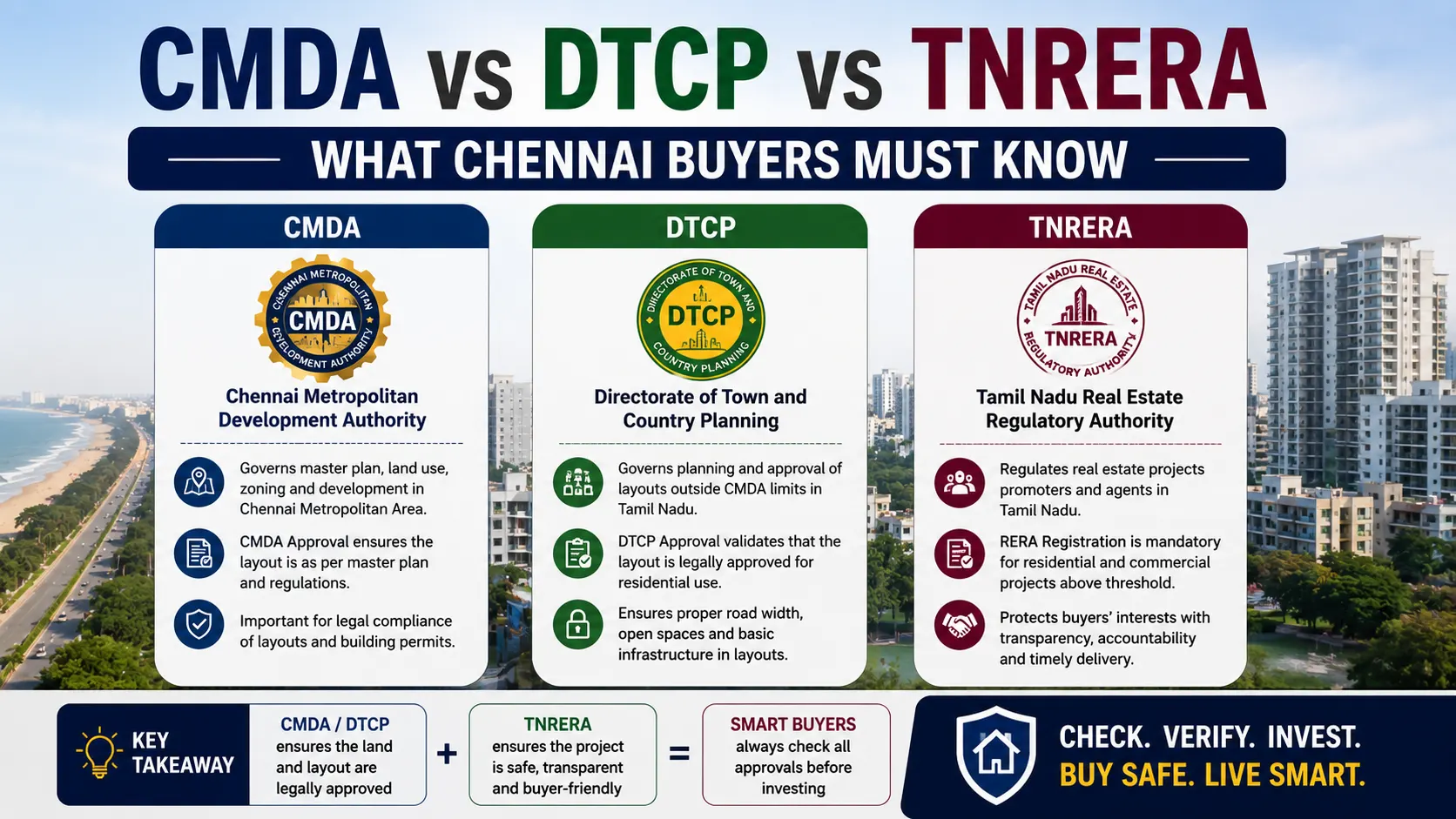
If you are planning to buy a flat, plot, villa, or gated community in Chennai, understanding the difference between CMDA, DTCP, and TNRERA is not optional—it is critical.
Thousands of Chennai buyers face:
- Loan rejection after booking
- Registration refusal
- Illegal construction notices
- RERA complaints with no relief
The root cause? Buying property without understanding approval authorities. This guide explains everything end-to-end, from land approval to buyer protection, so you can invest safely and confidently.
Why CMDA vs DTCP vs TNRERA Confuses Chennai Buyers
Most buyers wrongly assume:
- “RERA approved means fully legal."
- “Panchayat approval is enough."
- “DTCP is inferior to CMDA."
All three assumptions are false. Each authority has a completely different role, and none replaces the other.
Understanding the Three Authorities — The Big Picture
Authority / Role / What It Controls
- CMDA
- Planning Authority
- Chennai metro layouts & buildings
- DTCP
- Planning Authority
- Non-metro Tamil Nadu layouts
- TNRERA
- Regulatory Authority
- Builder behavior & buyer rights
What Is CMDA? (Chennai Metropolitan Development Authority)
The Chennai Metropolitan Development Authority (CMDA) is the highest planning authority for the Chennai Metropolitan Area (CMA).
Areas Under CMDA
CMDA governs:
- Chennai Corporation
- Tambaram
- Pallavaram
- Avadi
- Ambattur
- Porur
- Parts of Kanchipuram & Tiruvallur
-If your property lies inside these limits, CMDA approval is compulsory.
What CMDA Approves
- Residential plot layouts
- Apartment building plans
- Villas & row houses
- Commercial projects
- Land-use zoning (Residential, Mixed, Commercial)
Why CMDA Approval Is Non-Negotiable
- Mandatory for bank loans
- Mandatory for sub-registrar registration
- Ensures:
- Minimum road width
- OSR (Open Space Reservation)
- Fire & safety compliance
- Legal land conversion
No CMDA approval = High legal risk
What Is DTCP? (Directorate of Town and Country Planning)
The Directorate of Town and Country Planning (DTCP) controls all areas outside the CMDA boundary.
DTCP Jurisdiction
DTCP applies to:
- Chengalpattu outskirts
- Oragadam interiors
- Sriperumbudur rural stretches
- Semi-urban Tamil Nadu regions
What DTCP Approves
- Residential layouts (plots)
- Individual houses
- Small apartment projects
- Rural & town planning schemes
DTCP vs Panchayat Approval
Approval Type / Legal Status
- DTCP Final Approval
- Legally valid
- Panchayat Approval Only
- Not legally sufficient
- “Proposed DTCP”
- High risk
Many illegal layouts are falsely sold as “DTCP approved."
Always verify:
- DTCP approval number
- Approval date
- Whether it is Final or Conditional
What Is TNRERA? (Tamil Nadu Real Estate Regulatory Authority)
The Tamil Nadu Real Estate Regulatory Authority (TNRERA) exists only to protect buyers.
- It does NOT approve land or buildings.
Why TNRERA Was Introduced
Before RERA:
- Builders changed plans freely
- Delivery dates were meaningless
- Buyers had no authority to complain
The RERA Act (2016) fixed this.
What TNRERA Controls
- Project registration
- Builder disclosures
- Delivery timelines
- Buyer-builder agreements
- Complaint redressal
When TNRERA Registration Is Mandatory
A project must be registered if:
- Land area exceeds 500 sq. m, OR
- More than 8 units (flats or villas)
Exceptions:
- Individual house
- Small private builder projects under limits
What Buyers Must Check — Step-by-Step (High-Intent Section)
Step 1: Identify Authority
- Inside CMA → CMDA approval
- Outside CMA → DTCP approval
Step 2: Verify Planning Approval
- Layout approval number
- Building plan approval
- OSR details
Step 3: Check TNRERA Registration
- Project status
- Promised possession date
- Builder history
Step 4: Confirm Bank Loan Eligibility
- SBI, HDFC, LIC usually reject illegal layouts
Step 5: Cross-Verify Sale Agreement
- Carpet area clarity
- Penalty clauses
- Completion date
Chennai Buyers Must Never Ignore
- Approval applied for
- Regularization coming soon
- Panchayat approved only
- RERA will take care of everything
- Heavy discounts without approvals
FAQs
Is CMDA approval mandatory in Chennai?
Yes, for any property within the Chennai Metropolitan Area.
Is DTCP approval safe for investment?
Yes, only if the property lies outside CMDA jurisdiction.
Does TNRERA approval mean the land is legal?
No. TNRERA does not verify land legality.
Can a project have CMDA approval but no RERA registration?
Yes, if it falls below RERA thresholds.
Can I file a complaint under TNRERA?
Yes, for delays, false promises, or plan changes.
Which approval is most important?
All three serve different purposes—you need the right combination.
Conclusion
A legally safe Chennai property must have the following:
- Correct planning authority approval (CMDA or DTCP)
- TNRERA registration (if applicable)
- Bank loan eligibility
- Clear title documents
- Never confuse buyer protection with land legality.